
Deck Restoration in North Shore
Quick answer: Deck restoration in North Shore homes can be needed long before a deck is old. On our project, a treated pine deck only 8-10 years old had rotten boards and framing faults because it had missed regular cleaning and staining. We replaced the rotten timber, repaired the framing and followed the clean, sand and stain routine below.
This is a real My Homes Construct job, written up so you can check your own deck against it. It covers what the inspection found, why a fairly young deck failed, how we repaired it, and the simple routine that stops the same damage coming back.
What did the inspection find on this North Shore deck?
The inspection found rotten timber in the deck boards and problems in the framing underneath, which surprised the owner as much as it surprised us.
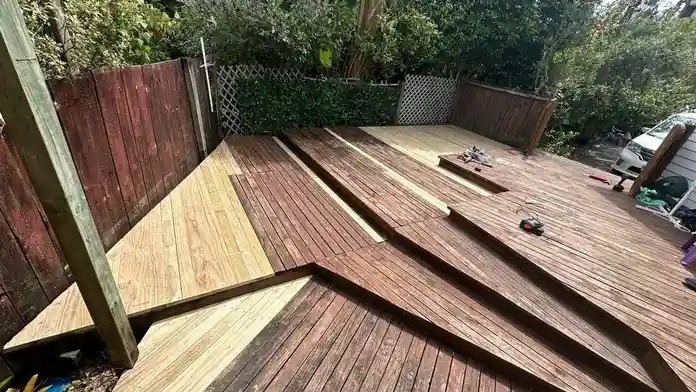
The deck was only 8-10 years old and built from treated pine. A deck of that age should still be in good shape. Instead, several boards had gone soft and the framing needed repair before the deck could be called safe again.
The photo at the top of this page was taken during the repair. The pale boards are the new treated pine we fitted. The darker, weathered boards beside them show what the rest of the deck surface looked like before it was cleaned, sanded and stained.
Why did an 8-10 year old treated pine deck start to rot?
The short answer is a lack of maintenance: the deck had not been cleaned and stained often enough to keep water out of the timber.
Treated pine resists decay, but it is not maintenance-free. Dirt, leaves and grime hold moisture against the boards. Once the stain wears thin, water soaks into the surface and the ends of the boards, and the timber stays damp for longer after every shower of rain.
Over a few wet Auckland winters, that cycle softens boards and works down into the joists and bearers. By the time a board feels spongy underfoot, the framing below it is often affected too. That is exactly what we found on this job.
Regular cleaning and staining are what break the cycle. They keep the surface sealed, help the timber dry quickly and let you spot a problem board while it is still a small repair.
How did we carry out the deck restoration in North Shore?
We followed the same sequence we recommend for any timber deck restoration, starting underneath and finishing with the protective coat on top:
- Inspect. We checked every board, the fixings and the framing below, so the quote covered the real problem rather than only what showed on the surface.
- Replace rotten boards. Rotten timber was cut out and replaced with good-quality treated pine.
- Fix the framing. The underlying framing issues were repaired, because a solid structure is what makes a deck safe and stops new boards failing early.
- Clean and sand. Cleaning and sanding remove dirt, grime and old stain so the new coating can bond to bare timber.
- Apply a fresh coat of stain. The stain protects the timber from sun and rain and brings the old and new boards to an even finish.
The client was thrilled with the result: the deck is safe to use again and looks the way it should. If your deck needs similar work, our deck restoration service covers board and framing repairs as well as the clean, sand and stain finish.
What signs mean your deck needs restoration?
Check your deck once a year, the way you would book a regular health check, and look closely for these warning signs:
- Discoloured or warped boards. Grey, blotchy or cupped boards show the stain has worn off and water is getting in.
- Cracks or splintering. Deep cracks let water into the heart of the board and are a hazard for bare feet.
- Loose nails or screws. Fixings that lift or spin often mean the timber around them has softened.
- Signs of mould or mildew. Green or black growth means the surface is staying damp for too long.
Also look underneath if you can reach. On this job the framing was part of the problem, and framing damage is easy to miss from the top. If you spot any of these signs, get a professional opinion before the damage spreads. We offer free consultations, so you can find out what the deck needs without committing to anything.
How often should a deck be cleaned and re-stained?
Clean the deck regularly through the year and plan on re-staining it every 2-3 years to protect the timber and keep it looking good.
That interval matches the semi-transparent stains listed on our deck painting and staining service. A deck in full sun, or one that gets heavy foot traffic, may need attention sooner. A sheltered deck may go a little longer. The test is simple: if water no longer beads on the surface after rain, the coating is due.
If you are deciding between a stain and a paint finish, our guide to deck staining versus deck painting compares how each one wears and what each needs to stay sound.
What everyday habits keep a deck healthy?
A few small habits do more for a timber deck than any one-off repair, because they stop moisture sitting on the boards:
- Keep it clean. Regularly remove leaves, debris and dirt so moisture does not build up between the boards.
- Let it breathe. Do not leave furniture, mats or planters in the same spot for long periods.
- Beware of harsh chemicals. Avoid harsh cleaners and bleach, which can damage the wood and the stain.
- Embrace the shade. Strong direct sun dries out the timber. Shade sails or umbrellas help on an exposed deck.
For a fuller seasonal checklist, read our deck maintenance tips for Auckland homes. Follow these steps and your deck can be a place to relax rather than a job waiting to happen.
Do you need a building consent to restore a deck?
Like-for-like repairs to an existing deck are often exempt from building consent, but it depends on the work and the deck.
Substantial replacement of structural framing, or making a deck larger or higher, can need a building consent. The building.govt.nz guidance on exempt decks, platforms and bridges, linked below, sets out where the limits sit. Our deck building consent guide for Auckland explains the rules in plain language.
If you are unsure, ask before work starts. We check the scope of the restoration against the rules as part of the consultation, so there are no surprises once the old boards come up.
Sources and further reading: building.govt.nz: exempt decks, platforms and bridges
Conclusion
A deck only 8-10 years old should not need major repairs, and this one did because maintenance slipped. Inspect your deck once a year, keep it clean and re-stain it on time. If you find soft or rotten boards, book a free consultation and we will tell you whether a repair or a full restoration is the right call.
Frequently Asked Questions
How long should a treated pine deck last before it needs restoring?
There is no fixed age. This deck needed new boards and framing repairs at only 8-10 years old because it had missed regular cleaning and staining, which is what holds back that kind of damage.
Can you restore a deck instead of replacing it?
Often, yes. If most of the structure is sound, rotten boards and damaged framing can be replaced and the deck cleaned, sanded and re-stained. We confirm which approach fits after inspecting the deck.
How often should I re-stain my deck?
Plan on every 2-3 years for a stained deck. Decks in full sun or with heavy use may need it sooner; when water stops beading on the surface, the coating is due.
What should I avoid when cleaning a timber deck?
Avoid harsh cleaners and bleach, which can damage the wood and strip the stain. Sweep off leaves and dirt often, wash with a gentle deck cleaner and let the boards dry fully before re-coating.
Projects Help Across Auckland
If this guide raised a question about your own home, the My Homes Construct Ltd team is here to help. We provide professional home-improvement services right across Auckland — North Shore, West Auckland, Central Auckland, East Auckland and South Auckland — along with the surrounding suburbs.
Every enquiry starts with free, no-obligation advice and a written quote. We're a registered building company and back our work with a workmanship warranty as per your quotation, so you can move forward with confidence.
When to Call a Professional
Plenty of home-improvement tasks are fine to tackle yourself, but it's worth knowing where the line is. If a job involves working at height, structural elements, water getting where it shouldn't, or anything you're not fully confident about, bringing in a professional is usually cheaper than fixing a DIY attempt that didn't hold up.
A good tradesperson also spots the things an untrained eye misses — the early warning signs that turn a small job today into a major repair next winter. If you're in any doubt, a free assessment costs nothing and gives you a clear, honest picture before you commit to anything.
Timing It Right in Auckland
Auckland's climate runs to its own calendar, and home-improvement projects go more smoothly when they're scheduled with that in mind. Booking weather-dependent work for a settled stretch avoids delays, and getting preventative jobs done before winter saves you from reacting once the heavy rain and coastal winds arrive.
If you're not sure where your property sits on that timeline, that's exactly the kind of thing a free assessment answers. We'll tell you honestly whether something needs attention now or can sensibly wait until the season suits.
A Quick Checklist for Auckland Homeowners
Whatever you decide to do next, a few simple principles will save you money and stress on any home-improvement job in Auckland.
- Act early — Auckland's wet, humid climate turns small problems into expensive ones faster than most people expect.
- Get it in writing — a clear, itemised written quote protects you and makes comparing options straightforward.
- Check it's a registered building company — it matters for quality, consent and warranty cover.
- Ask about the warranty — reputable Auckland tradespeople stand behind their workmanship, not just the materials.
- Think long-term value, not just the cheapest price — the lowest quote is rarely the best value once durability is factored in.
Keep these in mind and you'll avoid the most common — and most costly — mistakes we see on Auckland properties.
Need Professional Help in Auckland?
My Homes Construct Ltd provides expert projects and full home-improvement services across all Auckland suburbs. Get a free, no-obligation quote today.
This guide is published by Auckland builders and renovation specialists — a registered Auckland building company covering gutters, roofing, renovation, painting, decks and civil construction.