
Internal Gutter Cleaning: Clearing the Gutter Where Two Roofs Meet
Quick answer: Internal gutter cleaning means lifting leaves and silt out of the channel where two roofs meet or behind a parapet, then clearing the outlet and checking the overflow. Because an internal gutter can spill into the building when it blocks, it needs checking more often than an eaves gutter, and at least once a year.
This guide explains what builds up in an internal gutter, how to clean one safely, how often to do it, and the signs that the gutter needs more than a clean.
What is an internal gutter, and why does cleaning it matter more?
An internal gutter is a channel that sits inside the roof line, such as the gutter between two roofs, against a parapet wall or behind the fascia, and when it blocks the water can go into the building instead of over the edge.
An eaves gutter that overflows spills water outside, down the face of the house. An internal gutter has no open front edge, so a blocked outlet backs water up inside the roof structure. That is why the NZ metal roofing code of practice requires concealed gutters to have overflows within 1 metre of the downpipe, and why it says secret gutters should be wide enough to allow for cleaning.
The same code notes that internal gutters are hard to replace, so they are expected to last around 50 years. Regular cleaning is a large part of how they get there. Our guide to why NZ internal gutters overflow when not full explains what happens when they do not.
What builds up in an internal gutter?
Leaves, silt and moss build up in an internal gutter because two roof slopes wash everything they collect into one narrow channel.
| What you find | Why it matters | What to do |
|---|---|---|
| Leaves packed along the channel | They slow the flow and hold water against the metal | Lift them out by hand along the full run |
| Silt and roof grit | A wet bed that moss and weeds root into | Scoop it out, then rinse |
| Debris on the outlet guard or grating | The outlet blocks first and water backs up | Clear the guard and test the downpipe |
| Standing water after rain | Ponding shortens the life of coated steel | Clear it, then have the fall checked |
| A blocked overflow | The safety path for a blockage is gone | Clear it so water can escape outside |
The code of practice says regular gutter cleaning is required to remove leaves and other debris that restrict flow to downpipes, and that gratings or guards should be cleared of accumulated debris as part of normal maintenance. Moss is covered in our guide to moss in gutters.
What tools do you need to clean an internal gutter?
You need safe roof access, gloves, a scoop, bags and a hose to clean an internal gutter; no special chemicals are required.
- Safe access and fall protection suited to the roof, because most internal gutters can only be reached from it.
- Gloves to protect your hands from sharp metal edges and fixings.
- A plastic gutter scoop that will not scratch the coating in the channel.
- Heavy-duty rubbish bags to carry the debris down instead of dropping it.
- A garden hose to rinse the channel and test the outlet.
- A soft brush for silt that a scoop leaves behind.
How do you clean an internal gutter safely?
You clean an internal gutter safely by planning roof access first, working from the high end towards the outlet, lifting debris out by hand and then flushing the outlet.
- Plan the access. Most internal gutters can only be reached from the roof. WorkSafe treats working at height as a serious risk, so on a high or steep roof use proper fall protection or a professional.
- Protect any rainwater tank. Disconnect the downpipe to a drinking-water tank before you wash anything.
- Work towards the outlet. Start at the high end and lift leaves and silt out into a bag, so you are not pushing debris into the outlet.
- Clear the outlet and guard. Take the leaves off the sump guard or grating and clear the top of the downpipe by hand.
- Rinse gently. Use a hose and a soft brush. The code allows low-pressure washing only, with the jet aimed away from laps and openings.
- Test the flow. Run water down the channel and watch it drain freely through the outlet and out of the downpipe.
- Check the overflow. Make sure the overflow is open and discharges clear of the building.
If the gutter is high or hard to reach, our gutter cleaning service clears and flushes the full run and tells you what we find.
How often should an internal gutter be cleaned?
An internal gutter should be inspected at least once a year, and cleaned more often if trees overhang the roof or leaves collect quickly.
The metal roofing code of practice says roof inspection should happen at every washing interval or at least annually. Monier, the roof tile maker, gives the same advice for blocked gutters, downpipes and valleys: clean them at least once a year, and more often if the roof is surrounded by trees.
Timing matters as much as frequency. Clean after the main autumn leaf drop and check again before the heaviest winter rain. Look after big storms, because one storm can wash enough leaves off two roof slopes to block an outlet. If you notice water marks on a ceiling or wall near the gutter line after rain, check the gutter that day rather than waiting for the next scheduled clean.
Our gutter cleaning cost guide explains how often Auckland homes typically book a clean and what affects the price.
What does a blocked internal gutter look like on a real Auckland job?
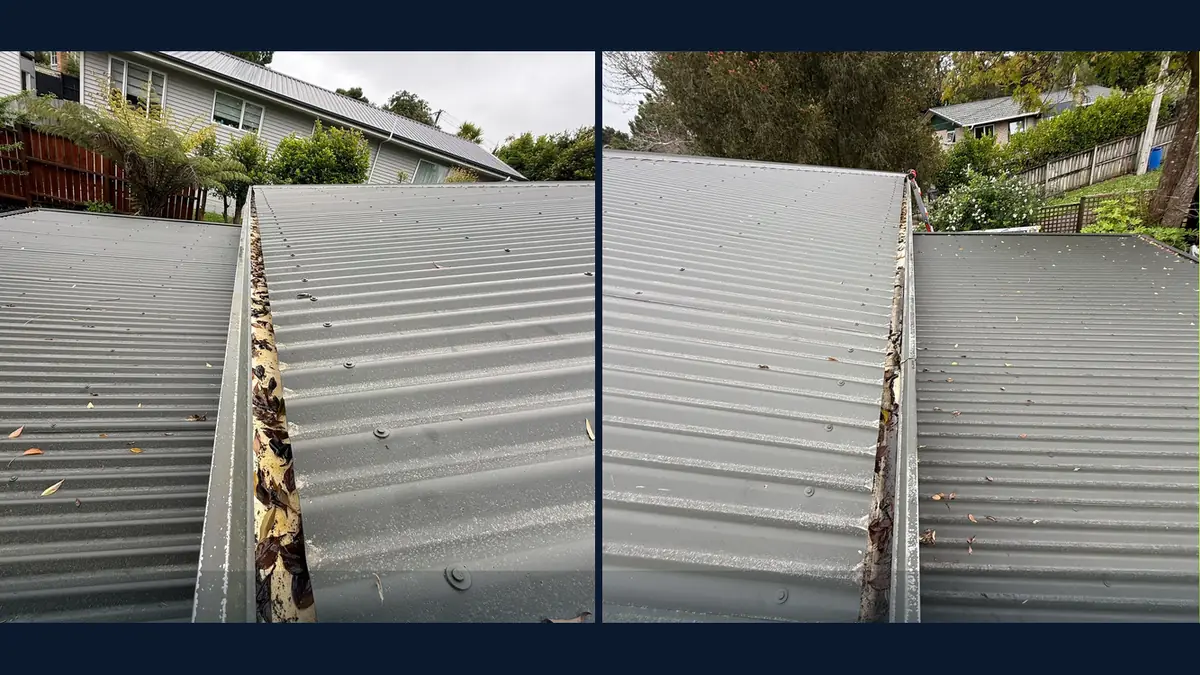
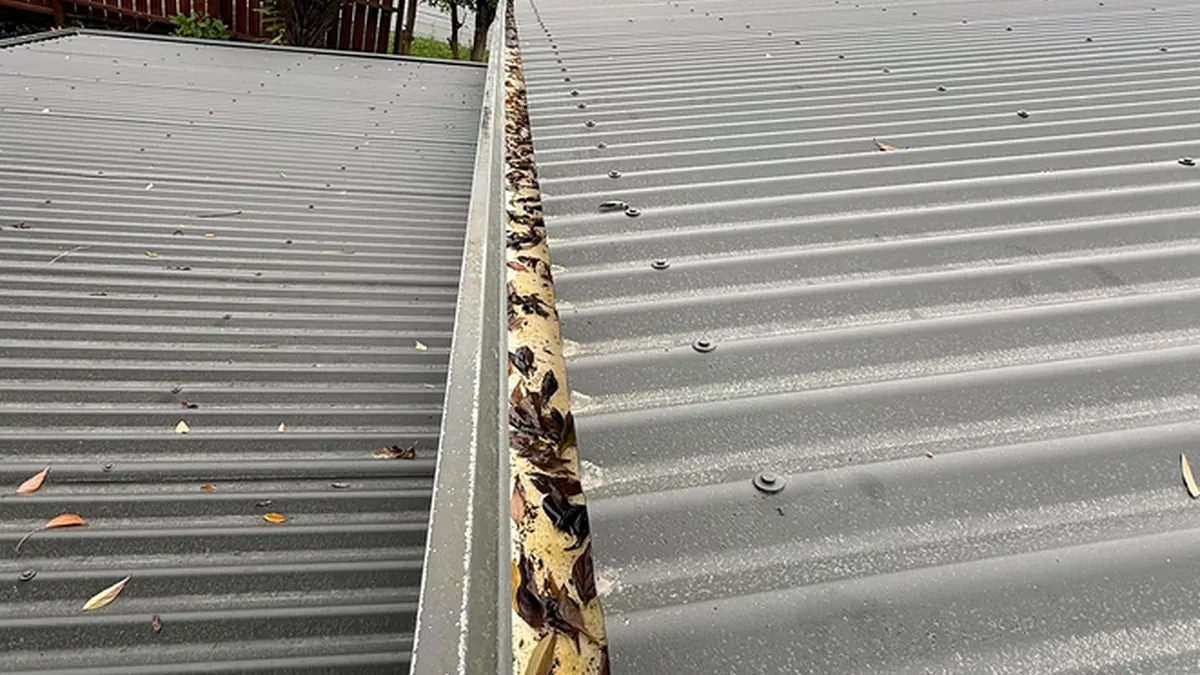
On one of our Auckland gutter jobs, leaf litter lay along the gutter where two corrugated metal roofs meet, with loose leaves on the roof sheets above it.
The photos in this guide come from that job and are shown as they were taken, with only our labels and contact details cropped away. One view looks along the channel from one end and shows dry leaves packed into it. The other view looks back from the opposite end, where leaves are still lying in the channel and scattered across both roofs.
That second view is the useful lesson. Leaves sitting on the roof sheets are the next blockage, because the next heavy rain washes them straight into the channel. Clearing an internal gutter is only half the job if the roof above it is still holding debris, which is why we check both and look at the trees around the house.
When is cleaning not enough for an internal gutter?
Cleaning is not enough when the internal gutter still holds water, leaks after it has been cleared, or overflows even though it is not full.
- Water still sits in the channel. The code says water should not pond more than 5 mm deep. Deeper ponding points to a fall or joint problem.
- Rust or holes in the channel. Corrosion under old debris often shows up only once the gutter is clean.
- Leaks with a clear gutter. A failed joint, seam or lining can let water in even when nothing is blocked.
- The outlet cannot keep up. An outlet that is too small for the roof area overflows in heavy rain however clean it is.
Old internal gutters can sometimes be relined, as our guide to rehabilitating an old box gutter explains. When an internal fascia gutter keeps failing, converting it to an external gutter removes the risk for good. For leaks and damaged sections, see our gutter repair service.
Sources
These are the primary sources behind the technical points in this guide.
- NZ Metal Roofing Manufacturers Code of Practice 5.4: gutters (internal, concealed and secret gutters)
- NZ Metal Roofing Manufacturers Code of Practice 5.6: outlets, sumps and overflows
- NZ Metal Roofing Manufacturers Code of Practice 14.18: avoiding problems (gutter cleaning and ponding)
- WorkSafe: working at height
The cleaning-frequency advice also draws on Monier NZ's published roof cleaning and maintenance guidance.
Conclusion
An internal gutter does the same job as any gutter, but when it blocks the water has nowhere to go except into the house. Inspect it at least once a year, clean it from the high end to the outlet, clear the outlet guard and check the overflow is open. If it still holds water, leaks or overflows after a clean, ask us for a free quote and we will tell you whether it needs a repair, a reline or a conversion.
Frequently Asked Questions
Can I clean an internal gutter myself?
You can if you can reach it safely, but most internal gutters are only reachable from the roof. Working at height is a serious fall risk, so on a high or steep roof use proper fall protection or book a professional. Never stand on a roof sheet that flexes or a fragile surface.
How often should internal gutters be cleaned in Auckland?
Inspect them at least once a year, and clean them more often if trees overhang the roof. Clean after the autumn leaf drop, check before winter rain and look again after big storms, because two roof slopes can wash a lot of debris into one channel.
How much does gutter cleaning cost in Auckland?
Our cost calculator puts standard gutter cleaning at $150 to $600, and a typical job takes two to four hours. Roof access, height, gutter length and how heavy the build-up is all move the price, so a quote after a look is the most reliable figure.
Should I put a leaf guard over an internal gutter?
A guard over the outlet or sump helps stop leaves blocking the downpipe, but it still needs clearing. The metal roofing code warns that gutter protection which traps debris or water against steel is not recommended, so a guard is not a reason to stop cleaning.
Gutter Help Across Auckland
If this guide raised a question about your own home, the My Homes Construct Ltd team is here to help. We provide professional gutter cleaning, repair and replacement services right across Auckland — North Shore, West Auckland, Central Auckland, East Auckland and South Auckland — along with the surrounding suburbs.
Every enquiry starts with free, no-obligation advice and a written quote. We're a registered building company and back our work with a workmanship warranty as per your quotation, so you can move forward with confidence.
When to Call a Professional
The trickiest part of any gutter cleaning, repair and replacement project is often knowing when to stop and call someone in. Warning signs worth taking seriously include recurring problems, damage that keeps spreading, anything involving safety or access at height, and work that touches the structure of your home.
In those situations a professional opinion pays for itself. We're always happy to take a look and tell you straight whether it's something you can manage yourself or a job better left to a registered building company — with no obligation either way.
Timing It Right in Auckland
One thing worth keeping in mind with gutter cleaning, repair and replacement in Auckland is how much the seasons shape the right approach. Coastal exposure, humidity and sudden downpours all affect both the work itself and how long the result lasts, so the best time to act isn't always obvious from the kerb.
Booking early in the season also means more flexibility on dates and fewer surprises. We're happy to map out sensible timing with you at no cost, so the job lands when conditions — and your budget — are right.
A Quick Checklist for Auckland Homeowners
Whatever you decide to do next, a few simple principles will save you money and stress on any gutter cleaning, repair and replacement job in Auckland.
- Act early — Auckland's wet, humid climate turns small problems into expensive ones faster than most people expect.
- Get it in writing — a clear, itemised written quote protects you and makes comparing options straightforward.
- Check it's a registered building company — it matters for quality, consent and warranty cover.
- Ask about the warranty — reputable Auckland tradespeople stand behind their workmanship, not just the materials.
- Think long-term value, not just the cheapest price — the lowest quote is rarely the best value once durability is factored in.
Keep these in mind and you'll avoid the most common — and most costly — mistakes we see on Auckland properties.
Need Professional Help in Auckland?
My Homes Construct Ltd provides expert gutter and full home-improvement services across all Auckland suburbs. Get a free, no-obligation quote today.
This guide is published by our Auckland building and renovation company — a registered Auckland building company covering gutters, roofing, renovation, painting, decks and civil construction.