Frequently Asked Questions
Q: How much does roof painting cost in Auckland?
Roof painting in Auckland typically starts from $1,500 for a standard residential roof, depending on size, pitch, condition and material. We provide free no-obligation quotes — call 022 315 8987.
Q: How often should I have my roof cleaned in Auckland?
Auckland's humid climate means most roofs benefit from professional cleaning every 2–3 years. Roofs with significant tree coverage or north-facing aspects may need annual cleaning to prevent moss and lichen buildup.
Q: What roofing materials do you work with?
We work with all common NZ roofing materials including concrete tiles, terracotta/clay tiles, Colorsteel, corrugated iron, fibrous cement, butynol membrane and decramastic tiles.
Q: Do you offer emergency roof leak repair in Auckland?
Yes. We offer rapid-response roof leak repair across Auckland. Call 022 315 8987 for urgent roofing issues and we will arrange same-day or next-day inspection where possible.
Q: Why do roofers make such a point about flashings?
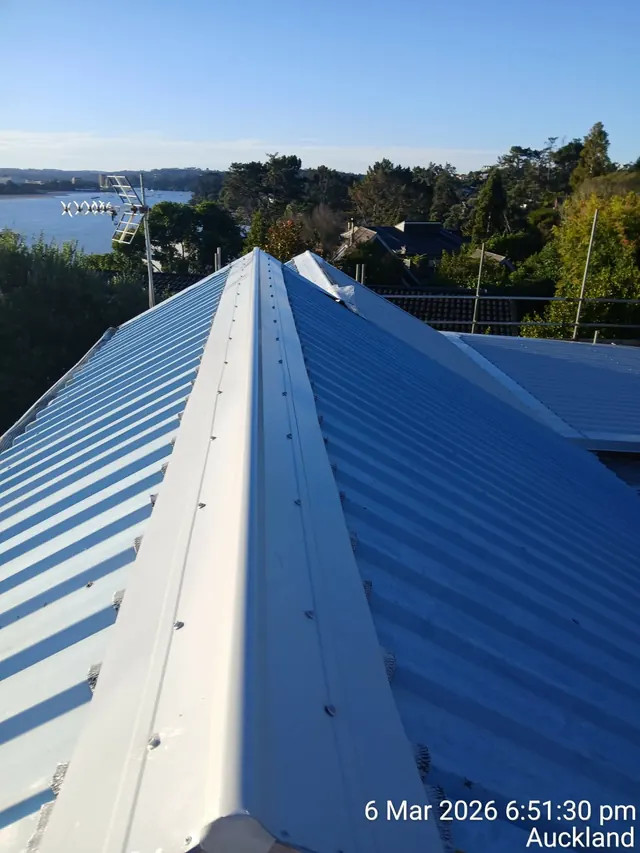
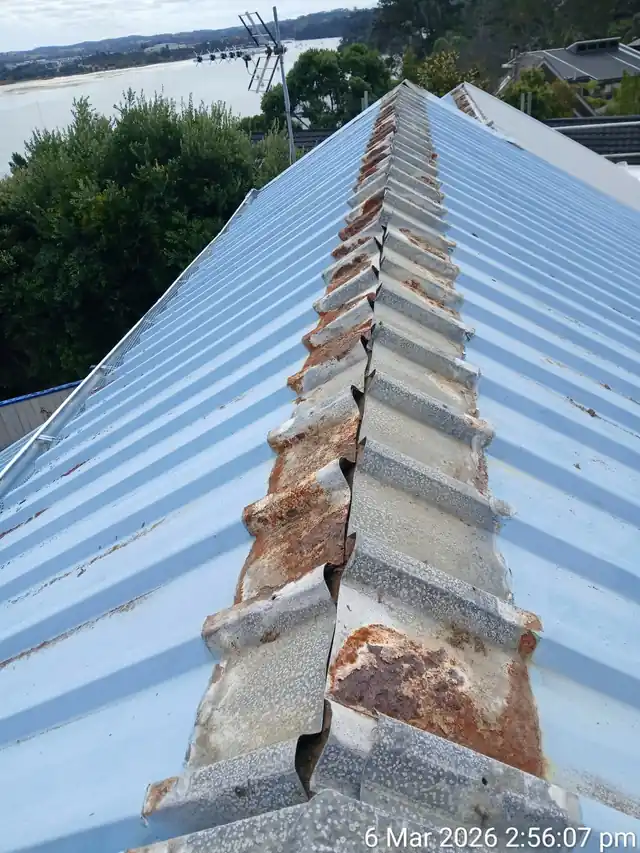
Because most roofs do not leak through the middle of a sheet — they leak at a junction. Flashings handle every junction: ridge, barge, apron, valley, penetration, wall abutment. Reusing tired flashings on a new roof is the most common way a new roof still leaks. Every flashing on a re-roof should be new and named in your quote.
Q: My roof is leaking right now — what should I do first?
Contain first, diagnose second. Move belongings, put a container under the drip, and if a ceiling is bulging with trapped water, pierce it at the low point in a controlled way rather than letting it collapse. Then call us on 022 315 8987 — we arrange same-day or next-day inspection for urgent roofing where possible, and we are reachable seven days.
Q: Why is the leak never directly above the ceiling stain?
Because water travels. It enters at a flashing or lap, runs along a purlin, a rafter or the underlay, and drops at the first low point — which can be metres from the entry. That is why leak-tracing is a real skill and why "just seal around the stain" fails so often. Proper diagnosis follows the path back uphill to the true entry point.
Q: How much does re-roofing cost in Auckland by house size?
Budget by roof area, not house price. On a small home up to 100m² long-run Colorsteel typically runs $12,000–$20,000 and concrete tile $18,000–$30,000. A 100–200m² home is usually $20,000–$38,000 in Colorsteel or $30,000–$55,000 in tile. Above 200m², expect $38,000–$45,000+ and $55,000–$65,000+ respectively. Your exact figure depends on pitch, access and what the old roof hides.
Q: What is a normal price range for a roof repair in Auckland?
Most residential roof repairs land between $150 and $1,800. A single cracked tile, a re-bedded ridge or one lifted flashing sits at the bottom of that band; multiple leak points, rusted valley replacement or work needing a harness system and edge protection sits at the top. We quote the repair in writing after inspection so you can compare it against replacement cost before committing.
Q: Do you charge for a roof inspection or quote?
No. Roof inspections and quotes are free and carry no obligation across every Auckland suburb we serve. We attend, assess the roof, photograph anything that matters and issue a written itemised quote. Phone estimates are guesses — a roof cannot be priced honestly from the ground or from a photo, so we always look at the actual roof first.
Q: Why do roofers quote per square metre, and is that a fair comparison?
A per-m² rate is a planning tool, not a quote. It covers sheet or tile plus labour, but it excludes the variables that move the price most: scaffolding, roof pitch, number of penetrations, valley and flashing lengths, and disposal of the old roof. Two quotes with the same per-m² rate can differ by thousands. Always compare total fixed prices with a written scope, not rates.
Q: What should a roof replacement quote actually include?
A complete quote names the product and profile, the underlay, all flashings and ridge capping, fixings, removal and disposal of the old roof, scaffolding or fall protection, gutter and downpipe work if affected, clean-up, and both the workmanship and manufacturer warranty terms. If any of those are missing they become variations later. Ask for anything excluded to be listed explicitly.