
Top 5 Gutter Issues Auckland Homeowners Face and How to Fix Them
Quick answer: The top five gutter issues for Auckland homeowners are clogged gutters, overflow from blocked downpipes, sagging or damaged gutters, leaks and rust, and poor installation. Clean and inspect twice a year, repair small faults early, and have the fall set correctly so water reaches the downpipes.
Auckland’s mix of heavy rain, gusty wind and leafy suburbs puts gutters under constant load. When they fail, water lands where it should not: down the walls, into the ground beside the house and, on some roofs, inside the building itself.
This guide covers the five problems we see most, how to recognise each one, what you can safely fix yourself and when to call a professional. It also covers the problem internal gutters cause when a blockage goes unseen, because hidden channels fail differently. Where a rule or measurement matters, we point to the official guidance rather than guess.
What are the five most common gutter problems in Auckland?
The five most common gutter problems in Auckland are blockages, overflow from blocked downpipes, sagging gutters, leaks and rust, and poor installation. Each has a typical sign and a first fix.
| Problem | Typical sign | First fix |
|---|---|---|
| Clogged gutters | Water spilling over the front edge, plants growing in the channel | Clear by hand, then flush |
| Blocked downpipes | Gutters that are clean but still overflow | Clear the outlet and test with a hose |
| Sagging or damaged gutters | Standing water, a dipped run, brackets pulling away | Re-fix brackets or replace the section |
| Leaks and rust | Drips at joints, stains below the gutter, flaking metal | Re-seal joints or replace rusted lengths |
| Poor installation | Water that pools or overshoots in heavy rain | Re-align, add support or re-size |
Why do gutters clog, and how do you clear them?
Gutters clog because leaves, twigs, moss and roof grit wash into the channel and build up faster than rain can flush them out. Twigs, moss and roof grit build up through the year, not only in autumn.
A blocked gutter overflows over the front edge, which soaks the ground beside the house and can stain or damage the wall cladding and landscaping.
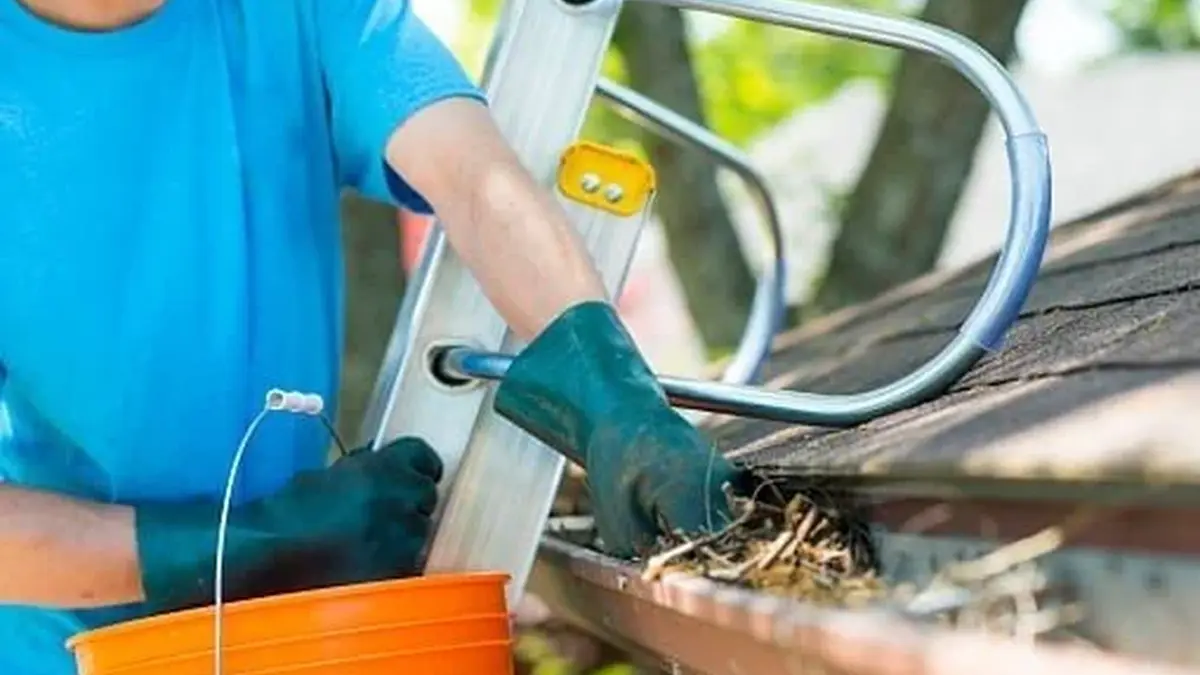
- Clean by hand twice a year, once before winter and once after leaf fall, and more often under overhanging trees. Our gutter cleaning guide sets out the method.
- Consider gutter guards if debris builds up quickly. They reduce cleaning but do not remove it, as we explain in our guide to gutter guards.
- Hire a professional for second-storey or steep roofs, where a fall is the real risk. Our gutter cleaning service covers this.
Why do gutters overflow when the downpipes are blocked?
Gutters overflow when downpipes are blocked because water has nowhere to go: the gutter fills from the outlet backwards and spills over the edge even though the channel itself is clear.
Downpipes block with leaves, dirt, roof grit and sometimes animal nests, usually at the outlet or at the first bend.
- Check the outlet first. Clear anything you can reach by hand.
- Flush with a garden hose from the top. If water backs up, the blockage is further down and needs a professional.
- Check the size. A downpipe that overflows in every heavy storm may be too small or too few for the roof area. Our guide to downpipe size and placement explains what to ask an installer.
What makes gutters sag or pull away, and how is it fixed?
Gutters sag when the brackets or hangers loosen, when blocked gutters carry the extra weight of water and debris, or when the fascia behind them has softened.
Once a gutter sags, water stands in the low spot, which speeds up rust and puts more weight on the fixings, so the fault grows. The fix depends on the cause:
- Loose or missing brackets can be re-fixed or added at the spacing the manufacturer specifies. See how far apart gutter hangers should be.
- Soft fascia has to be repaired first, because new brackets will not hold in rotten timber.
- Damaged sections are replaced in a material suited to the site. Our sagging gutter repair guide walks through the steps.
Why do gutters leak and rust?
Gutters leak and rust because joints open as the metal moves with temperature, coatings wear through, and standing water and debris keep the metal wet. Coastal areas make it worse because salt in the air speeds up corrosion.
Small leaks at a joint can often be re-sealed, but rust that has eaten through the metal means that length has to be replaced. Choose a material that suits the site: PVC does not rust, aluminium is a common choice near the coast, and Colorsteel suits most Auckland homes. Our gutter replacement page compares the options.
To find the source of a drip, see our guides to fixing a dripping gutter and fixing a leaking gutter joint.
What goes wrong when gutters are installed badly?
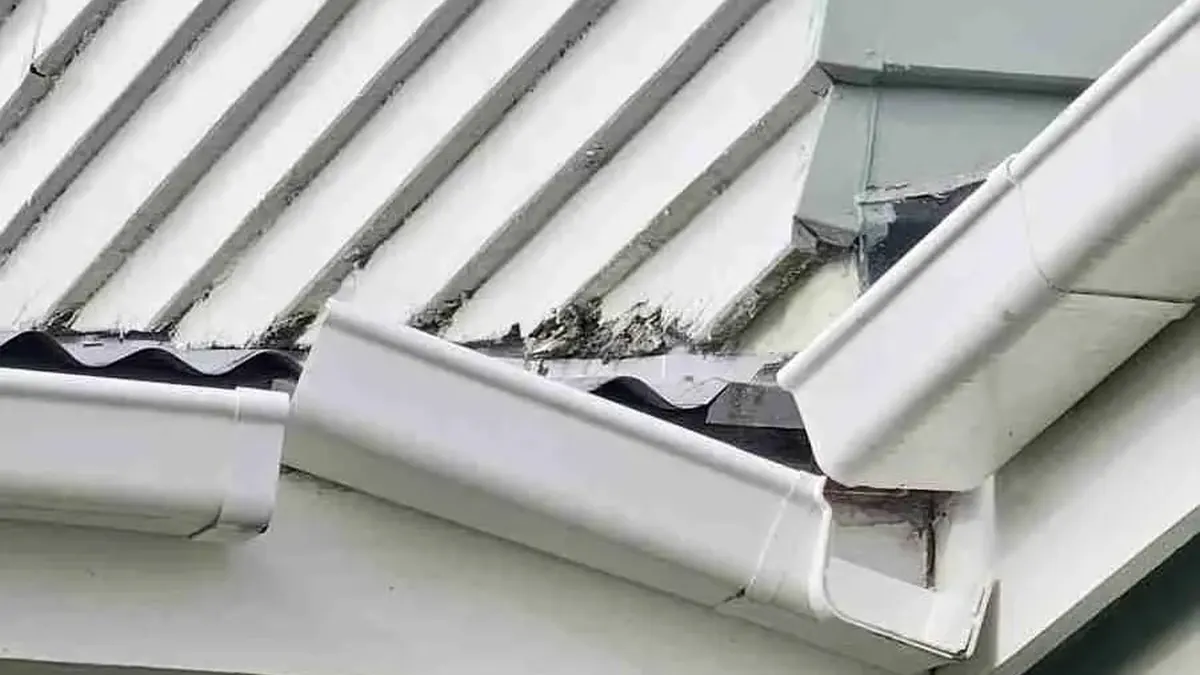
Badly installed gutters fail because the fall is wrong, the supports are too far apart, or the gutter and downpipes are too small for the roof they serve.
The symptoms are water that pools in one section, spills at the corners in a heavy shower or overshoots the gutter entirely. Each of these can be corrected without replacing the whole system. A professional can re-align the run, add supports or fit larger outlets, and our gutter re-alignment service is built for this. Follow the manufacturer’s specification for fall and spacing, and the Building Code clause on surface water for how roof water must be managed.
Are internal gutters a different kind of problem?
Yes. Internal gutters, also called box or concealed gutters, behave differently because they sit inside the roofline, so a blockage or failed joint can send water into the building instead of onto the ground.
The most costly problem internal gutters cause is hidden damage: stains on a ceiling or soffit, or rot in the fascia and framing, that appear long after the fault began. They are hard to inspect from the ground, so a specialist usually has to check them from the roof. Two guides cover this in detail: why internal gutters overflow when they are not full and converting an internal gutter to an external one.
What should you do first when you spot a gutter problem?
When you spot a gutter problem, work through these steps in order, and stop at the first one that needs a professional.
- Watch the gutter in rain from the ground and note exactly where water leaves.
- Look for the obvious cause: a blocked outlet, a dipped section or a joint that is open.
- Clear debris safely. Use a stable ladder or, better, a professional, and read WorkSafe’s guidance on working at height before you climb.
- Test the downpipes with a hose to confirm water flows freely.
- Book a professional if water enters the building, the fascia is soft, or the fault returns after cleaning. We can inspect on a free assessment.
How do you prevent gutter problems in Auckland?
Prevention is cheaper than repair: most gutter faults start as a small blockage or a loose fixing that gets worse with every storm.
- Inspect and clean twice a year, and after a major storm.
- Fix small faults early, such as a loose bracket or an open joint.
- Keep trees trimmed back from the roof and gutters.
- Choose materials for the site, especially near the coast.
- Get a professional inspection every few years to check the fall, the fixings and the fascia behind them.
Sources and further reading: WorkSafe: working at height · Building Code clause E1 – surface water (building.govt.nz) · Building Code clause E2 – external moisture (building.govt.nz)
Related guides: how far apart gutter hangers should be · how to fix a leaking gutter joint · how much gutter cleaning costs in Auckland
Conclusion
Gutter problems in Auckland are common but manageable: clear blockages, fix loose fixings and small leaks early, and have faulty installation corrected before the next storm. These steps protect your home from water damage and mould, and a professional inspection will confirm what your gutters need.
Frequently Asked Questions
How often should I clean my gutters in Auckland?
Clean your gutters twice a year, before winter and after autumn leaf fall, to prevent clogs and keep water draining properly. If you have large trees near your home, clean them more often.
What materials are best for Auckland gutters?
It depends on the site. PVC suits a budget and does not rust, Colorsteel suits most Auckland homes, and aluminium is a common choice near the coast. Choose for your location and ask your installer to explain the trade-offs.
How do I know if my gutters need repair?
Look for sagging, rust, leaks, stains under the gutter or standing water. These are signs that the fall, the fixings or a joint have failed and need attention before the damage spreads to the fascia and walls.
Should I repair or replace damaged gutters?
Repair suits isolated faults such as an open joint or a loose bracket, while replacement suits widespread rust, repeated leaks or a gutter that is too small. A professional inspection will tell you which applies to your home.
Can I fix gutter problems myself?
You can clear debris and flush downpipes if you can reach them safely from a stable ladder. Work at height is a real risk, so leave second-storey roofs, rotten fascia and repeat faults to a professional.
Gutter Help Across Auckland
Need a hand putting this into practice? My Homes Construct Ltd delivers gutter cleaning, repair and replacement services throughout Auckland, from the North Shore through to South Auckland, with the local knowledge to get the details right the first time.
Get in touch for a free, no-obligation quote. You'll deal with the same registered building company team across your whole project, with quality materials and a workmanship warranty as standard.
When to Call a Professional
Plenty of gutter cleaning, repair and replacement tasks are fine to tackle yourself, but it's worth knowing where the line is. If a job involves working at height, structural elements, water getting where it shouldn't, or anything you're not fully confident about, bringing in a professional is usually cheaper than fixing a DIY attempt that didn't hold up.
A good tradesperson also spots the things an untrained eye misses — the early warning signs that turn a small job today into a major repair next winter. If you're in any doubt, a free assessment costs nothing and gives you a clear, honest picture before you commit to anything.
Timing It Right in Auckland
Auckland's climate runs to its own calendar, and gutter cleaning, repair and replacement projects go more smoothly when they're scheduled with that in mind. Booking weather-dependent work for a settled stretch avoids delays, and getting preventative jobs done before winter saves you from reacting once the heavy rain and coastal winds arrive.
If you're not sure where your property sits on that timeline, that's exactly the kind of thing a free assessment answers. We'll tell you honestly whether something needs attention now or can sensibly wait until the season suits.
A Quick Checklist for Auckland Homeowners
Whatever you decide to do next, a few simple principles will save you money and stress on any gutter cleaning, repair and replacement job in Auckland.
- Act early — Auckland's wet, humid climate turns small problems into expensive ones faster than most people expect.
- Get it in writing — a clear, itemised written quote protects you and makes comparing options straightforward.
- Check it's a registered building company — it matters for quality, consent and warranty cover.
- Ask about the warranty — reputable Auckland tradespeople stand behind their workmanship, not just the materials.
- Think long-term value, not just the cheapest price — the lowest quote is rarely the best value once durability is factored in.
Keep these in mind and you'll avoid the most common — and most costly — mistakes we see on Auckland properties.
Need Professional Help in Auckland?
My Homes Construct Ltd provides expert gutter and full home-improvement services across all Auckland suburbs. Get a free, no-obligation quote today.
This guide is published by registered Auckland builders — a registered Auckland building company covering gutters, roofing, renovation, painting, decks and civil construction.