
Long Run Roofing in Auckland: A Guide to Long-Run Steel Profiles, Fixings and Care
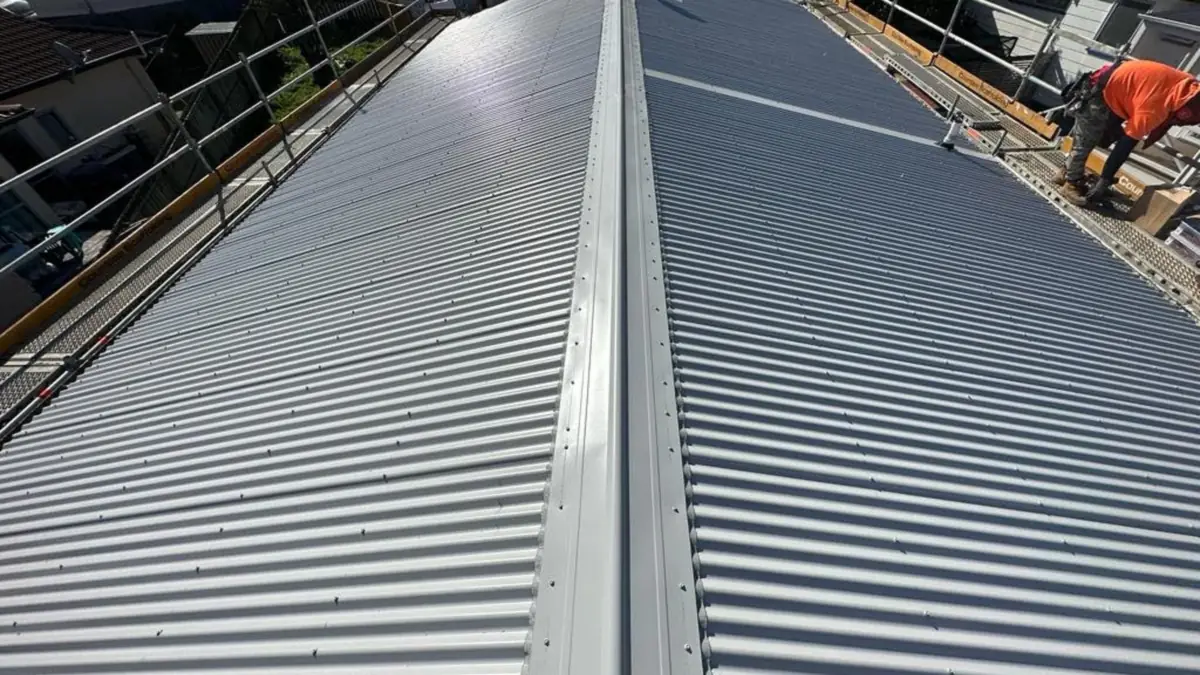
Quick answer: Long run roofing means roll-formed steel sheets cut to the full length of the roof slope, usually in a corrugate or trapezoidal profile. It is light, fast to install and sheds heavy rain well. Its lifespan depends on the coating grade, fastener class and installation details more than on the brand.
Below you will find how the two common profiles differ, what a sound specification includes, how colour affects a steel roof and how to look after it.
What is long-run steel roofing?
Long-run steel roofing is profiled metal sheeting that is roll-formed to the length of your roof and fixed in single lengths from ridge to eaves. It is one of the materials used in our house re-roofing service. The best-known New Zealand brand of pre-painted steel is COLORSTEEL, made by NZ Steel.
Because each sheet is formed to order, the material is bought before work starts and the number of end laps is kept to a minimum. End laps are a weak point, so the New Zealand Metal Roofing Manufacturers installation guide says they should be avoided where possible and sealed when they cannot be. Long-run steel is also lighter than concrete tile, which is why it is a common choice when a roof is replaced.
Which profile suits your home: corrugate or trapezoidal?
Both profiles are widely used on Auckland homes, and the right choice depends on roof pitch, appearance and the manufacturer’s specification for your site.
| Corrugate | Trapezoidal | |
|---|---|---|
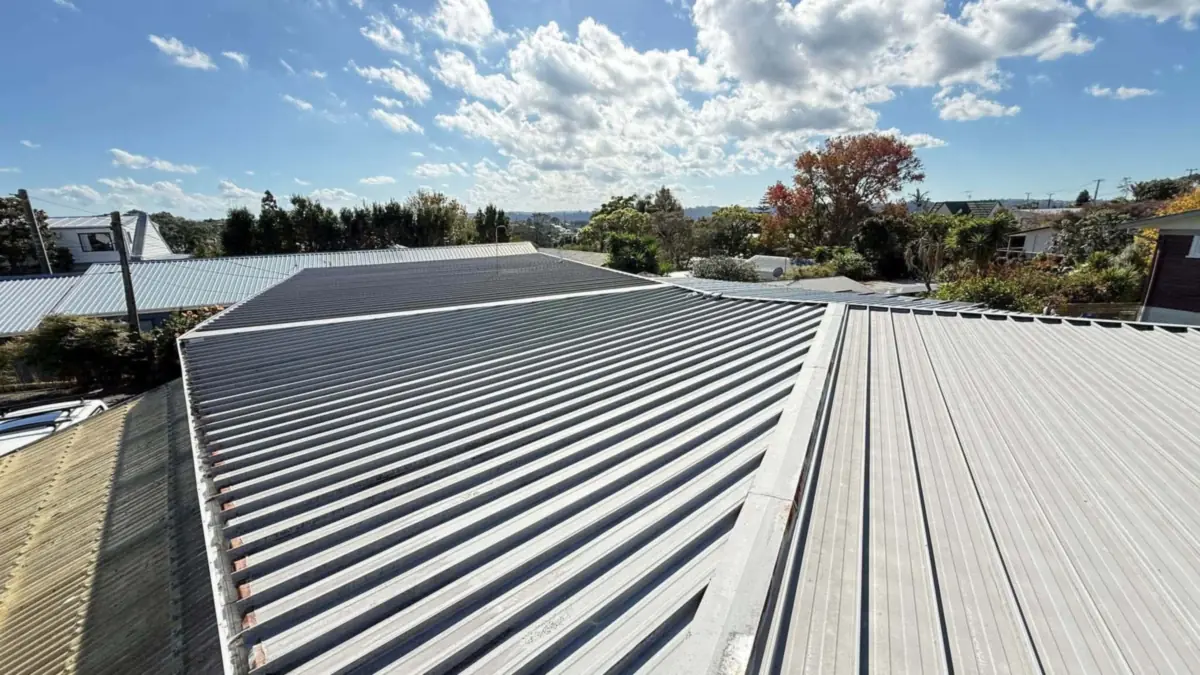
| Look | Rounded waves, traditional character | Flat pans with raised ribs, a cleaner modern line |
| Minimum pitch | Eight degrees for standard corrugate; some deeper profiles can go lower with an eaves flashing if the manufacturer allows it | Set by the manufacturer for each profile; check before ordering |
| Drip edge | Cannot be satisfactorily turned down at the eaves, so low-pitch use relies on an eaves flashing | Can be turned down to form a positive drip into the gutter |
| Typical use | Villas, bungalows, sheds, character renovations | New builds, extensions and contemporary re-roofs |
A roofer should confirm the minimum pitch for the exact profile in writing, because a roof below the minimum leaks at every lap.
What should a long-run roof specification include?
A complete specification names every component, because anything left out becomes a variation after work starts.
- Product and profile. Steel grade, coating system, thickness and profile name.
- Fasteners. Class 4 as the minimum for severe environments and Class 5 for very severe ones, matched to the cladding metal and fitted with sealing washers.
- Underlay and flashings. New flashings at every junction, and the underlay type named.
- Gutter and eaves detail. Overhang into the gutter and the fall of the gutter itself.
- Removal, disposal and clean-up. Including a magnet sweep of the grounds for loose fixings.
- Warranty documents. Both the workmanship cover and the manufacturer cover, with their conditions.
Our re-roofing cost guide shows how those items affect price, and the consent guide covers when a re-roof needs approval.
Our sister brand publishes its own Colorsteel and long-run roofing page, which quotes installed Colorsteel at $90 to $140 per square metre. Treat any per-metre rate as a planning figure, because it excludes scaffolding, pitch, penetrations and removal of the old roof.
How does roof colour affect a steel roof?
Colour affects how much heat a steel roof absorbs, how much it moves in the sun and how fast fading shows.
Darker roofs absorb more solar heat and push more of it into the roof space, which matters in Auckland summers and in homes with limited ceiling insulation. The metal roofing manufacturers’ guide also notes that thermal expansion and contraction is most evident with darker colours and long spans, so long sheets need fixings that allow for movement. Deep reds and dark blues tend to show weathering sooner than greys and greens on the same coating.
Our guide to the best roof colour for NZ homes goes further on heat, fading and local rules.
Which installation details separate a good steel roof from a poor one?
The details that matter most are invisible on handover day, which is why it pays to ask about them before you sign.
- Cutting by shear. Friction blades and high-speed saws must not be used on coated steel because hot metal particles embed in the surface and rust.
- Daily sweep-down. Swarf left on the roof causes rust stains that are often mistaken for early failure of the roof itself.
- Screws, not nails. The code of practice recommends screws because driven nails can back out over time.
- Sealed laps. Unavoidable end laps are sealed with a double bead of sealant or closed-cell tape.
- Matching accessories. Sheeting and accessories from the same manufacturer weather the same way and avoid visible colour variance.
These points come from the manufacturers’ own installation guide, so a roofer who follows it should be comfortable discussing them.
How do you look after a long-run steel roof?
Steel roofs need a small amount of regular care, and following it is usually a condition of the manufacturer’s warranty.
NZ Steel states that normal rain washing removes most contaminants from roofs, while areas the rain does not reach need manual washing. Those areas include the undersides of gutters, soffits, fascias, sheltered roof sections and spots beneath solar panels. Wash with water and a sponge or a soft nylon-bristled brush, and keep gutters free of leaves, because trapped debris holds moisture against the metal. Read the full maintenance bulletin for your environment category.
The roof maintenance checklist sets out the full routine, and rusty roof repair covers what to do if corrosion has already started.
Can you replace a tile roof with long-run steel?
Yes, but it is not a like-for-like swap, so treat it as a consented job with engineering input.
Going from heavy tile to light steel changes how the structure is loaded and braced, and some frames relied on the weight of the tiles. Replacing profiled metal with profiled metal in the same position is the standard example of work that is generally exempt once the old roof has passed its 15-year durability period, so confirm your case with the council before ordering product.
How long does a long-run steel roof last?
A well-installed and maintained steel roof lasts for decades, and the Building Code sets a floor of 15 years for roof cladding.
NZ Steel notes that the Building Code durability requirement is a minimum of 15 years for non-structural roofing, including valleys, and that it is met when the product is maintained as recommended. Manufacturer warranties on steel and tile commonly sit in the 15 to 50 year range depending on grade and environment. Coastal salt, unwashed sheltered areas and overhanging trees all shorten that. A roof that has never been washed ages faster than one on the same street that has.
The roof warranty guide explains what manufacturer and installer cover typically requires.
Sources
These are the primary New Zealand sources behind the facts in this guide.
Conclusion
Long-run steel is a sound choice for most Auckland roofs when the profile, fasteners and installation details are specified properly and the roof is washed on a sensible schedule. Ask for the specification in writing and compare quotes line by line for your project.
Frequently Asked Questions
Is a steel roof noisy in the rain?
Steel is generally louder in heavy rain than concrete tile, which is quieter and holds its look on character homes. Underlay choice and a lined roof space affect how much you hear, so ask your roofer what is included in the specification.
What is the minimum pitch for a corrugate roof?
The installation guide says standard corrugate must not be terminated below eight degrees, because it cannot be satisfactorily turned down at the eaves. Some deeper profiles can be used lower with an eaves flashing, so get the minimum for your exact profile confirmed in writing.
Do I need to wash a steel roof?
Rain does most of the work, but areas the rain cannot reach need a manual wash to protect the coating and the warranty. These include gutter undersides, soffits and sheltered roof sections, and the frequency depends on how close you are to the sea.
Can I walk on a steel roof?
Do not assume it is safe. Profiled roofs are rated for limited point loads, translucent sheets must never be walked on, and a worker carrying tools can exceed the rated load. Use the pans rather than the ribs if access is unavoidable.
Roofing Help Across Auckland
Need a hand putting this into practice? My Homes Construct Ltd delivers roofing and re-roofing services throughout Auckland, from the North Shore through to South Auckland, with the local knowledge to get the details right the first time.
Get in touch for a free, no-obligation quote. You'll deal with the same registered building company team across your whole project, with quality materials and a workmanship warranty as standard.
When to Call a Professional
Plenty of roofing and re-roofing tasks are fine to tackle yourself, but it's worth knowing where the line is. If a job involves working at height, structural elements, water getting where it shouldn't, or anything you're not fully confident about, bringing in a professional is usually cheaper than fixing a DIY attempt that didn't hold up.
A good tradesperson also spots the things an untrained eye misses — the early warning signs that turn a small job today into a major repair next winter. If you're in any doubt, a free assessment costs nothing and gives you a clear, honest picture before you commit to anything.
Timing It Right in Auckland
Timing matters more than most Auckland homeowners realise with roofing and re-roofing work. The drier spells from late spring through summer are ideal for anything weather-sensitive, while the wetter winter months are when hidden faults tend to reveal themselves — which makes autumn a smart time for a preventative check before the rain sets in.
Planning ahead also means you're not scrambling for an emergency call-out at the worst possible moment. A quick seasonal inspection costs little and often catches the small issues that would otherwise become urgent — and expensive — repairs once Auckland's weather turns.
A Quick Checklist for Auckland Homeowners
Whatever you decide to do next, a few simple principles will save you money and stress on any roofing and re-roofing job in Auckland.
- Act early — Auckland's wet, humid climate turns small problems into expensive ones faster than most people expect.
- Get it in writing — a clear, itemised written quote protects you and makes comparing options straightforward.
- Check it's a registered building company — it matters for quality, consent and warranty cover.
- Ask about the warranty — reputable Auckland tradespeople stand behind their workmanship, not just the materials.
- Think long-term value, not just the cheapest price — the lowest quote is rarely the best value once durability is factored in.
Keep these in mind and you'll avoid the most common — and most costly — mistakes we see on Auckland properties.
Need Professional Help in Auckland?
My Homes Construct Ltd provides expert roofing and full home-improvement services across all Auckland suburbs. Get a free, no-obligation quote today.
This guide is published by My Homes Construct Ltd, a registered Auckland building company — a registered Auckland building company covering gutters, roofing, renovation, painting, decks and civil construction.